Overview
Ghost of Yotei is Sucker Punch Productions' follow-up to their acclaimed 2020 hit Ghost of Tsushima, released on October 2, 2025 exclusively for PlayStation 5. Where Tsushima told the story of Jin Sakai defending a Japanese island from Mongol invasion, Yotei takes a dramatic leap — geographically and tonally — to Ezo, the northern Japanese island now known as Hokkaido, in 1603, the turbulent dawn of the Edo period.
The result earned a Metacritic score of 87 from 112+ critic reviews, an 89 on OpenCritic, and over 3.3 million copies sold within two months of launch. Ghost of Yotei entered 2025's Game of the Year conversation on day one and remained there through year's end — a sequel that improves on its predecessor in nearly every meaningful dimension.
The Story of Atsu
Ghost of Yotei introduces Atsu — a haunted mercenary who has spent sixteen years hunting the six killers who slaughtered her family. The Yotei Six are the game's primary antagonists: each a distinct character with their own philosophy, territory, and grip on Ezo's frontier. Atsu is not simply a warrior pursuing a list of names. She is a person who has shaped her entire identity around revenge, and who must reckon with who she is — or would be — once that revenge is complete.
This psychological core gives Ghost of Yotei emotional depth that most open-world games avoid. Atsu's arc, which critics described as one of gaming's strongest female protagonist stories of 2025, traces the distance between the mercenary she has become and the person she might still choose to be.
The game's non-linear structure allows players to pursue most of the Yotei Six in any order — the Snake serves as the opening confrontation, and Lord Saito as the final boss, but everything between is genuinely flexible. This structure creates a sense of agency rare in narrative-driven games: the world changes based on which targets you've eliminated and how, and allies respond to your choices and reputation.
Ezo: A World Defined by Wilderness
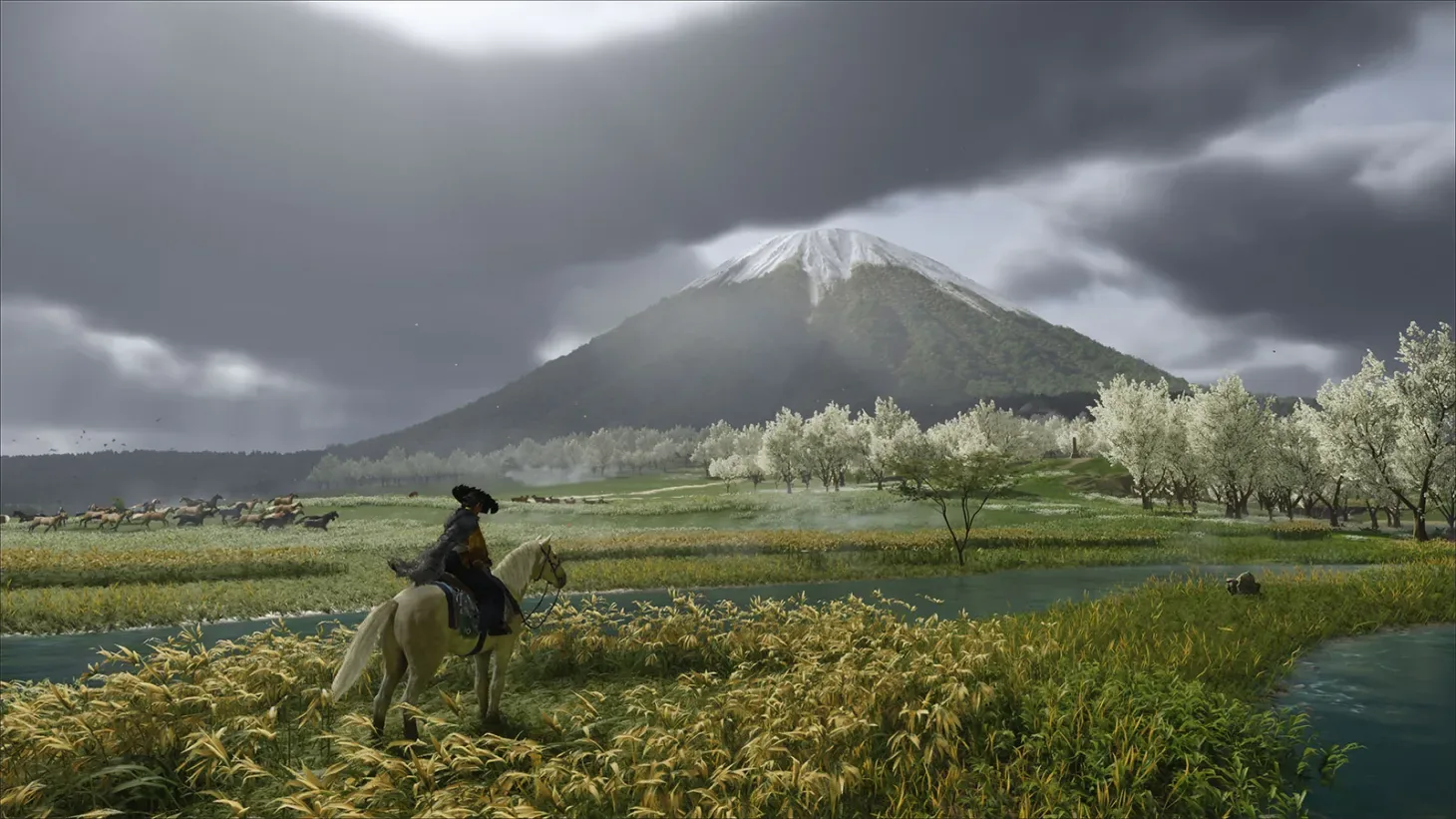
Ghost of Yotei's greatest achievement is its environment. Ezo in 1603 is not the manicured coastal beauty of Tsushima — it is raw, cold, and enormous. Sucker Punch built the world around the real landscape surrounding Mount Yotei in Hokkaido, delivering an open world defined by:
- Dynamic weather systems — snow accumulation, rain, fog, and authentic aurora borealis programmed to reflect Hokkaido's actual climate
- Seasonal progression — the world visibly changes through the game's timeline, with gameplay implications at each stage
- Dense ancient forests — trees whose canopy behavior changes with weather and season
- Ainu cultural presence — the indigenous people of Ezo, integrated into the world with specificity and care
- Coastal fishing settlements and exposed northern sea cliffs
- Mountain passes with altitude-dependent weather and patrol patterns
The seasonal changes are not cosmetic. Snow accumulation affects enemy movement speed and Atsu's traversal options. Certain quests and encounters only unlock in specific weather conditions. The aurora borealis, appearing on clear winter nights, turns entire hillside environments into something the photography mode exists specifically to capture.
Screenshots taken in Ghost of Yotei's wilderness have circulated extensively on social media — a testament to Sucker Punch's environmental artistry that doubles as organic marketing.
Combat: Wolf, Blade, and Improvisation
Ghost of Yotei expands Tsushima's combat with three meaningful additions that create fundamentally different tactical situations:
The Wolf Companion
Atsu can summon a wolf that integrates into both combat and stealth. In combat, the wolf distracts enemies, guards against flanking, and creates attack openings by pinning opponents. In stealth, the wolf draws guard attention and holds it, allowing Atsu to reposition or execute silent kills.
The relationship between Atsu and the wolf is not incidental — it is central to how the game frames her character. Two warriors who found each other. Their bond is earned through play rather than cutscene.
Disarm System
New disarm attacks allow either Atsu or enemies to lose their weapons mid-fight. Dropped weapons can be picked up, used briefly, and thrown as projectiles by either party. This creates improvisational combat moments absent from Tsushima: a fight where you lose your sword and must improvise with a dropped spear, or where disarming an enemy commander shifts the entire encounter dynamic.
Weapon Variety
Atsu's arsenal includes tools derived from both Japanese weaponry and Ainu cultural practices, each with genuinely distinct rhythms and engagement ranges. Critics were unanimous on this point: every weapon feels different enough to play that switching between them changes your approach, not just your animation set.
Returning from Tsushima are combination attacks requiring parry timing and unblockable attacks requiring evasion — the dual defensive reads that made Ghost of Tsushima's combat demanding without being punishing.
Stealth: Refined and Expanded
Atsu is a more capable infiltrator than Jin Sakai, and the stealth system reflects that specialization. Her toolset includes equipment tied to Ainu cultural practices, movement that exploits environmental features organically, and guard detection systems that respond to both sound and light with genuine nuance.
The non-linear mission design extends to infiltration. Most objectives can be approached through direct confrontation or full stealth, but Ghost of Yotei's stealth path is designed as a satisfying primary mode rather than an alternative to avoid combat. Playing Atsu as a pure shadow — eliminating the Yotei Six without a single open engagement — is a viable and deeply rewarding playstyle.
Side Content: Meaningfully Improved
Ghost of Yotei improves substantially on Tsushima's secondary content quality. Where Tsushima's side quests were sometimes functional rather than memorable, Yotei's are designed as standalone stories:
- Tales of Ezo's settlers adapting to frontier life
- Ainu traditions under pressure from colonial encroachment
- Mysteries tied to specific locations that reward exploration
- Ally recruitment chains with their own narrative arcs
The ally system adds strategic depth to exploration: finding and earning the trust of Ezo's inhabitants extends Atsu's capabilities and resources. These relationships develop across the game's runtime. Allies remember your decisions and their situations evolve in response.
Technical Performance on PS5
Ghost of Yotei runs in two modes on PlayStation 5:
| Mode | Resolution | Frame Rate |
|---|---|---|
| Performance | 1440p–1800p Dynamic | 60 fps |
| Quality | 4K | 30 fps |
Performance mode is the recommended experience — 60fps combat and traversal feel distinctly better than 30fps, and the dynamic resolution remains visually excellent. The game has virtually no loading seams across Ezo's enormous landscape, with environmental density maintained from populated settlements to deep wilderness.
No PC version has been announced as of May 2026.
Ghost of Tsushima vs. Ghost of Yotei
| Metric | Ghost of Tsushima | Ghost of Yotei |
|---|---|---|
| Metacritic | 83 (PS4) / 87 (Director's Cut) | 87 |
| OpenCritic | ~88 | 89 |
| Setting | 1274 Tsushima | 1603 Ezo (Hokkaido) |
| Protagonist | Jin Sakai | Atsu |
| Combat additions | Stance system | Wolf companion, disarm |
| World weather | Static beauty | Dynamic seasons + aurora |
Yotei matches Tsushima's critical ceiling while improving measurably in story coherence, world dynamism, combat depth, and side quest quality. This is a genuine sequel improvement.
System Requirements
| Specification | Details |
|---|---|
| Platform | PlayStation 5 exclusive |
| Storage | Approximately 80 GB |
| HDR | Full HDR10 support |
| PC Version | Not announced as of May 2026 |
Frequently Asked Questions
Do I need to play Ghost of Tsushima first? Not required — Ghost of Yotei is a completely standalone story with no narrative connection to Jin Sakai. Familiarity with Tsushima's gameplay helps you appreciate the improvements, but first-time players will find Yotei fully accessible.
Is the wolf optional? The wolf is introduced early and woven into Atsu's story throughout. Its tactical use in combat and stealth is optional moment-to-moment, but its presence is consistent.
How long is Ghost of Yotei? The main story takes approximately 25–35 hours. Full completion with side quests and world exploration extends to 50–70 hours depending on playstyle.
Is it coming to PC? No announcement has been made as of May 2026.
Score: 9/10 — One of the best open-world action games of 2025. Atsu's revenge story, Ezo's dynamic wilderness, and the refined combat system make Ghost of Yotei essential for every PS5 owner.