Overview
Monster Hunter Wilds is Capcom's most ambitious entry in their long-running hunting RPG franchise, released on February 28, 2025 for PC (Steam), PlayStation 5, and Xbox Series X/S. Building directly on the acclaimed foundation of Monster Hunter: World (2018), Wilds eliminates the remaining barriers between hunter and ecosystem — loading screens, biome boundaries, and moment-to-moment friction — to deliver the most immersive Monster Hunter experience ever created.
The result: a Metacritic score of 90 — the highest-rated game of 2025 at release — and sales that positioned it as one of Capcom's fastest-selling titles in franchise history. After the measured improvements of Monster Hunter Rise, Wilds returns to World's scale and ambition, then surpasses both.
The Forbidden Lands: A Truly Living Ecosystem
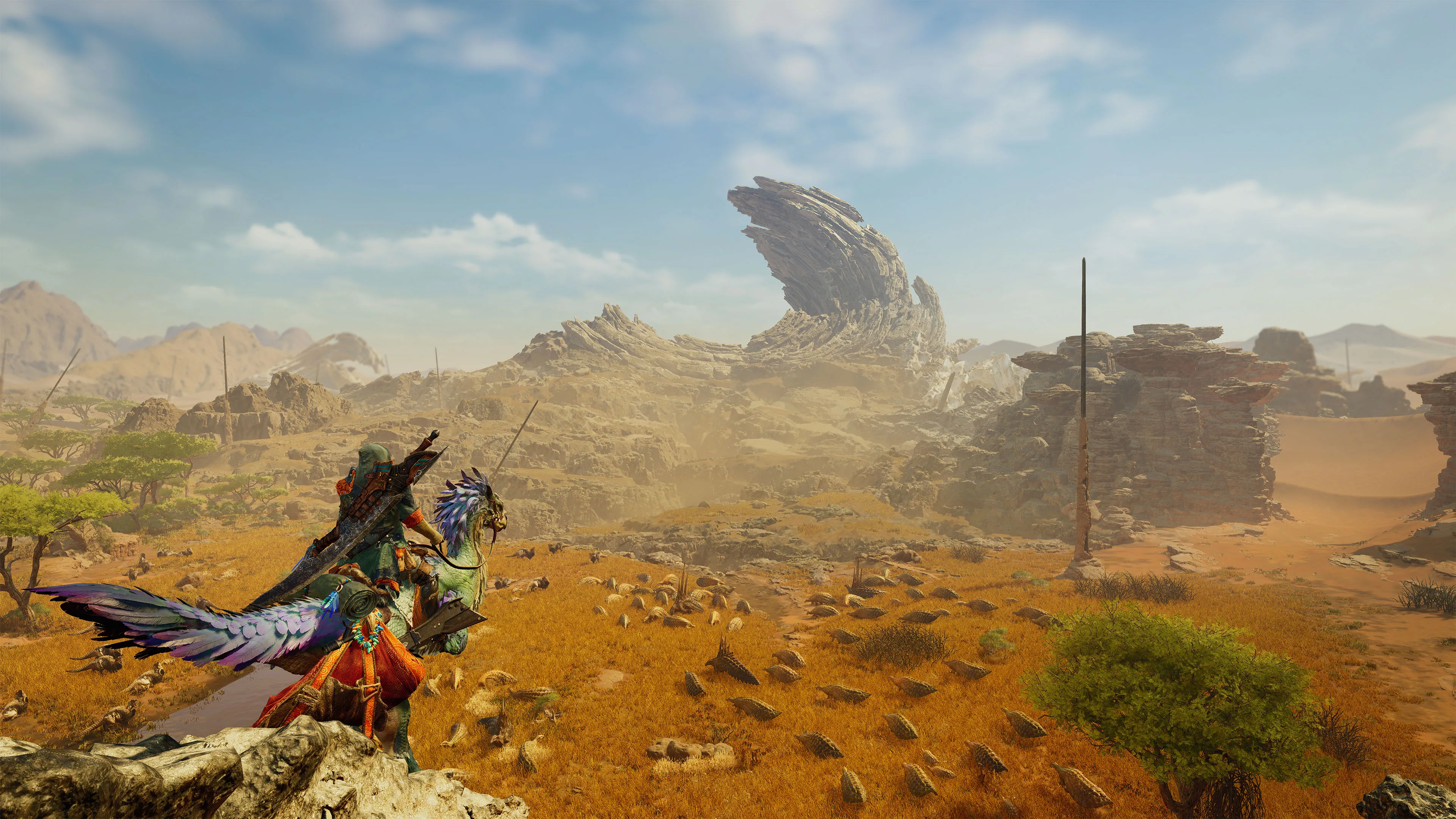
Monster Hunter Wilds takes place in the Forbidden Lands — a previously unmapped region made accessible by environmental shifts. Unlike every previous Monster Hunter game, where biomes were distinct zones separated by loading screens, the Forbidden Lands operates as a seamlessly connected open world. Players move from sun-scorched desert plains through dense wetland forest into volcanic rock formations without interruption.
The ecosystem is genuinely dynamic. Weather cycles alter the environment in real time:
- Sand Squalls reduce visibility across desert biomes and change which monsters appear and where
- Downpours transform dry riverbeds into flowing waterways, opening new movement corridors
- Seasonal shifts change available flora, fauna, and monster migration patterns across the entire map
Monster behavior reflects ecological reality. Predators and prey exist in actual relationships — disturbing a herbivore herd draws nearby carnivores. A monster pursued to exhaustion will seek water, rest, or territory. The Forbidden Lands feels alive in a way no previous Monster Hunter game approached.
Focus Mode: The Most Important Combat Addition in Years
Focus Mode is the single most impactful mechanical addition Monster Hunter Wilds introduces, and it fundamentally changes how every hunt plays.
Holding the Focus Mode button enters a precision targeting state that allows hunters to:
- Aim attacks at specific monster body parts — targeting a wing joint, eye socket, or tail base rather than broadly hitting whatever is closest
- Identify wound locations created by repeated targeted strikes
- Execute wound-specific attacks that deal exceptional damage to damaged parts, with animations unique to each wound type and weapon
This transforms combat from broad damage accumulation to surgical deconstruction. A Lance hunter who systematically wounds a monster's leg joint and then exploits that wound is doing fundamentally different work than one who blocks and counters randomly. The strategic depth added by Focus Mode is not cosmetic — it rewards knowledge, patience, and methodical planning with measurably better outcomes.
Every one of the game's 14 weapon types has been designed around Focus Mode. The mechanic elevates the entire roster.
Dual Weapon Slots: Mid-Hunt Tactical Flexibility
Players can now equip two complete weapon loadouts before a hunt and swap between them at any Supply Cache found in the field. This is more transformative than it sounds.
Monster Hunter's preparation-before-hunt loop has always been a core feature and a friction point simultaneously — choosing the wrong elemental weapon against a monster's weakness meant inefficiency for the entire hunt. With dual weapon slots, switching from a Fire weapon to an Ice weapon when a monster enters its second phase is a mid-mission tactical decision rather than a failure state.
This is particularly valuable for multi-monster hunts and encounters where monsters change elemental vulnerabilities across phases. The full 14-weapon roster becomes practically accessible in ways no previous entry achieved.
New Monsters and the Forbidden Lands Roster
Wilds introduces a roster built around biome diversity. Arkveld — the apex predator of the Forbidden Lands — is a flagship monster whose encounter design represents some of Capcom's most ambitious hunt architecture. The fight demands understanding of Arkveld's behavioral patterns, wound management, and phase transitions in ways that feel like a final exam for everything Focus Mode teaches.
The full monster roster balances new Forbidden Lands creatures with returning favorites updated for modern hardware and Wilds' new mechanical systems. Monster behavior complexity is higher than any previous game — creatures respond to wound states, weather conditions, hunger, and inter-species territory disputes in ways that make each hunt feel genuinely unique.
First-Ever Crossplay: Friends Across All Platforms
Monster Hunter Wilds introduces crossplay for the first time in franchise history — PC, PlayStation 5, and Xbox Series X/S hunters can all share the same session. Given that Monster Hunter's cooperative multiplayer is arguably its defining feature, this is a transformational addition.
Friend groups fractured across platforms can now hunt together without compromise. The SOS flare mechanic — allowing players to call for help mid-hunt — returns with improved visibility, and the lobby system has been updated to reduce the friction of group formation.
Progression and the Crafting Loop
The Monster Hunter crafting loop — hunt monsters, harvest materials, craft gear from those materials, use that gear to hunt harder monsters — remains as compelling as ever. Wilds expands the system:
- More complex material hierarchies specific to the Forbidden Lands
- Augmentation systems that allow end-game gear customization
- Broader weapon upgrade paths per weapon type
- Camp and Supply Cache upgrades that extend field capabilities
The learning curve for new players remains steeper than most modern action games. Monster Hunter's vocabulary of mechanics, materials, and monster behaviors requires genuine investment. Wilds makes improvements to onboarding but does not flatten the complexity that makes the franchise deeply rewarding. Expect 5–10 hours before the full depth of the hunting loop becomes clear. After that, hundreds of hours disappear naturally.
Visual and Technical Performance
Monster Hunter Wilds is built on RE Engine — Capcom's proprietary technology — and represents the engine's most visually demanding deployment. Monster fur simulation, dynamic weather particle systems, and the seamless open world combine to push current hardware significantly.
On PS5 and Xbox Series X, the game runs at consistent 60fps in Performance mode. The PC version launched with notable shader compilation stuttering and frame rate inconsistency on high-end hardware — issues Capcom addressed through multiple patches in the weeks following release. By mid-March 2025, the majority of performance complaints were resolved, though the PC version remains more demanding than typical AAA releases.
System Requirements (PC)
| Spec | Minimum (1080p/Low/30fps) | Recommended (1080p/High/60fps) | Ultra (4K/Ultra) |
|---|---|---|---|
| OS | Windows 10 64-bit | Windows 10 64-bit | Windows 10/11 64-bit |
| CPU | Intel Core i5-10400 | Intel Core i5-10400 | Intel Core i5-10400 |
| RAM | 16 GB | 16 GB | 16 GB |
| GPU | NVIDIA GTX 1660 (8GB) | NVIDIA RTX 2060 Super / AMD RX 6600 | NVIDIA RTX 4070 Ti Super / AMD RX 7800 XT |
| VRAM | 8 GB | 8 GB | 16 GB |
| Storage | 75 GB SSD | 75 GB SSD | 75 GB NVMe SSD |
| DirectStorage | Supported | Supported | Supported |
Note: An SSD is required. Frame generation via DLSS 3 or FSR 3 is strongly recommended for consistent 60fps at High settings and above.
Console Performance
| Platform | Mode | Resolution | FPS |
|---|---|---|---|
| PlayStation 5 | Performance | 1440p Dynamic | 60 fps |
| PlayStation 5 | Quality | 4K | 30 fps |
| Xbox Series X | Performance | 1440p | 60 fps |
| Xbox Series S | Performance | 1080p | 60 fps |
How Monster Hunter Wilds Compares to World
| Metric | Monster Hunter: World | Monster Hunter Wilds |
|---|---|---|
| Metacritic (PC) | 90 | 90 |
| Biome structure | Zone-based with loading | Seamless open world |
| Combat precision | Attack-type based | Focus Mode wound system |
| Weapon loadout | Single pre-hunt | Dual mid-hunt swap |
| Crossplay | None | PC + PS5 + Xbox |
| Weather impact | Minimal | Biome-altering |
Wilds matches World's critical score while surpassing it mechanically. The seamless world and Focus Mode alone justify the upgrade.
Frequently Asked Questions
Is Monster Hunter Wilds good for beginners? Better than previous entries, but Monster Hunter's complexity is real. Expect 5–10 hours of investment before the full hunting loop becomes clear. Once it does, it is one of the most compelling gameplay loops available.
How long is Monster Hunter Wilds? The main story takes 30–40 hours. End-game High Rank content extends play to 200+ hours for dedicated hunters.
Does it require an internet connection? No — fully playable offline in single-player. Online cooperative play is optional.
What is Focus Mode? Holding the Focus Mode button enters a targeting state where you aim attacks at specific body parts. Repeated strikes create wounds that unlock powerful wound-specific attacks unique to each weapon type.
Score: 9/10 — The best Monster Hunter ever made. Focus Mode, seamless biomes, and crossplay represent genuine evolution for a franchise that has always delivered one of gaming's most compelling gameplay loops.